Understanding Percentages: A Quick Refresher
Percentages represent parts of a whole, expressed as a fraction of 100. They're used everywhere, from calculating sale discounts to understanding test scores. This guide shows you how to easily calculate what percentage 22 represents of 30. We'll break down the process step-by-step, making it easy to understand, even if percentages aren't your strongest suit.
Calculating "What Percent of 30 is 22?"
Let's solve this using a clear, three-step method. Don't worry – this isn't rocket science!
Step 1: Formulate the Fraction
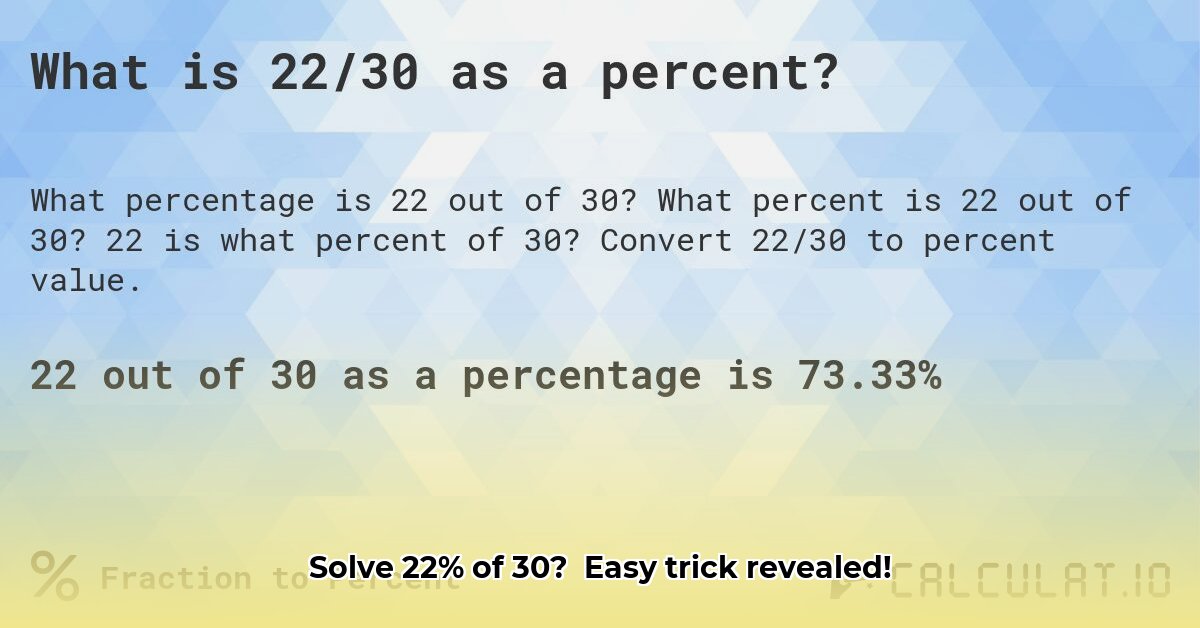
First, we create a fraction. The "part" (22) goes on top (numerator), and the "whole" (30) goes on the bottom (denominator): 22/30. This fraction represents the proportion of 22 compared to 30.
Step 2: Convert to Decimal
Now, divide the numerator (22) by the denominator (30): 22 ÷ 30 ≈ 0.7333. This decimal represents the same proportion, but as a decimal value instead of a fraction.
Step 3: Convert to Percentage
Finally, to express the proportion as a percentage, multiply the decimal by 100: 0.7333 × 100 ≈ 73.33%. Therefore, 22 is approximately 73.33% of 30.
The Percentage Formula: Understanding the Math
The method above uses the core percentage formula: (Part / Whole) * 100 = Percentage. This formula works because it essentially converts the part-to-whole ratio into an equivalent ratio out of 100 (which is the definition of a percentage).
Another Example: Reinforcing the Concept
Let's try another example to cement your understanding. What percentage of 60 is 18?
- Fraction: 18/60
- Decimal: 18 ÷ 60 = 0.3
- Percentage: 0.3 × 100 = 30%
Therefore, 18 is 30% of 60.
Python Code for Percentage Calculation
For those comfortable with coding, here's a simple Python function to automate these calculations:
def calculate_percentage(part, whole):
  """Calculates the percentage of 'part' relative to 'whole'."""
  return (part / whole) * 100
result = calculate_percentage(22, 30)
print(f"22 is {result:.2f}% of 30")
This function mirrors the steps we've discussed, providing a quick way to calculate percentages for various scenarios.
Practice Problems: Test Your Skills
Here are a few practice problems to solidify your understanding:
- What percent of 40 is 16?
- What percent of 75 is 30?
- What percent of 150 is 45?
Answers: 40%, 40%, 30%
Conclusion: Mastering Percentages
Understanding percentages is a valuable skill. By following the simple steps outlined here and practicing regularly, you'll be able to confidently calculate percentages in any situation. Remember the fundamental formula and use the Python code to help automate calculations as needed. Keep practicing, and you'll master this essential mathematical concept!